
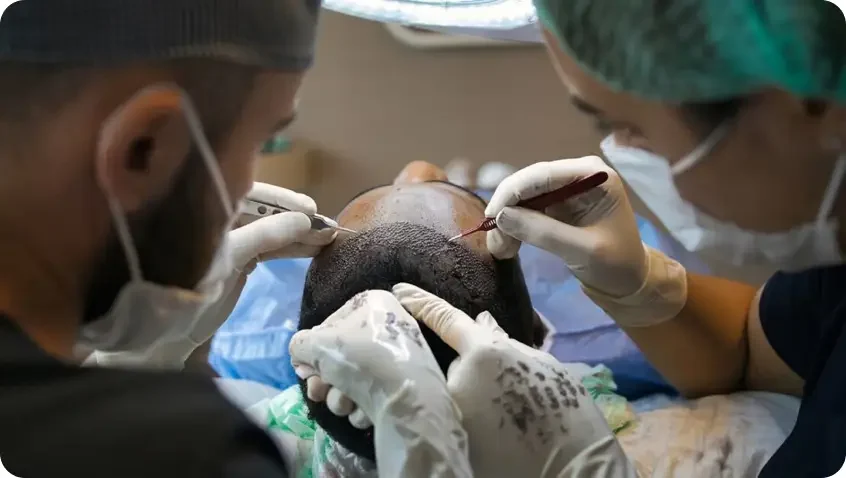
If you are at the start of your research, this is the page to read first. It explains what a hair transplant actually is, how the main techniques differ, who is a good candidate, what results and recovery look like, and what it costs — in plain language, without sales pressure.
What a hair transplant is
A hair transplant moves your own hair follicles from a donor area — usually the back and sides of the head, where hair is genetically resistant to balding — to areas that are thinning or bald. Because the follicles keep their resistance after being moved, the transplanted hair is permanent. No donor from another person is involved, and no artificial hair is used.
The two techniques that matter today
FUE (Follicular Unit Extraction) extracts individual follicles with a micro-punch, leaving no linear scar. In Sapphire FUE, the recipient channels are opened with a sapphire blade, which makes finer incisions than steel and speeds healing. DHI (Direct Hair Implantation) skips the pre-made channels: each follicle is loaded into a Choi implanter pen and placed directly, giving the surgeon control over angle and depth graft by graft. DHI excels at hairlines and density work; Sapphire FUE is efficient for larger areas; many cases combine both. Our DHI vs Sapphire FUE comparison goes deeper. The old “strip” method (FUT), which leaves a linear scar, is rarely chosen today.
Who is a good candidate
Three things matter more than age: a stable hair loss pattern (usually from the mid-twenties onward), a sufficient donor area, and realistic goals. Diffuse thinning across the whole scalp responds poorly; concentrated loss at the hairline, temples or crown responds well. Women are candidates too — traction alopecia, high hairlines and stable patterns with a dense donor area are common cases. See the best age for a hair transplant and our guide for women.
What happens on procedure day
Local anaesthesia, then extraction from the donor area, then implantation — a session of several hours depending on graft count, with breaks. Most patients describe it as long but comfortable. You walk out the same day with a protected scalp and detailed aftercare instructions.
Recovery and results timeline
| Stage | What to expect |
|---|---|
| Days 1–7 | Mild swelling, scabbing; first gentle wash around day 4; most patients fly home by day 5 |
| Weeks 3–8 | Shock loss — transplanted hairs shed; follicles remain (normal) |
| Months 3–6 | New growth begins, thin at first |
| Months 6–12 | Density builds, hair thickens |
| Months 12–15 | Final result |
The full week-by-week recovery guide covers each stage in detail.
How many grafts do you need?
A graft is a follicular unit of 1–4 hairs. Hairline refinement may need 1,000–1,500 grafts; a receded hairline and temples 2,000–3,000; hairline plus crown 3,000–4,500. Only an examination of your scalp and donor area gives a real number — treat any graft count quoted without seeing you as marketing.
What it costs
In Albania, a complete hair transplant typically costs €1,500–€3,000; Nouvelle Clinique’s all-inclusive package is €2,500 with hotel, transfers and medications included. The same procedure in Italy, Germany or the UK commonly costs €6,000–€10,000+. Full breakdown in the 2026 cost guide.
How to choose a clinic
Four checks: a licensed supervising physician you can verify in a public registry, a straight answer to “who performs the implantation”, a fixed written quote after assessment, and reviews you can verify independently. Nouvelle Clinique operates under a physician licensed by the Order of Physicians of Albania and holds a 4.9-star rating across 160+ Google reviews.
Frequently asked questions
Does a hair transplant hurt?
The anaesthetic injections sting briefly; the procedure itself is painless. Mild soreness for a few days afterwards is normal and managed with the medications provided.
Are the results permanent?
Yes — transplanted follicles keep their genetic resistance to hair loss. Native hair around them can still thin over time, which is why stabilising treatments are often recommended.
Will it look natural?
With modern DHI and Sapphire FUE and an experienced team, yes: single follicles placed at natural angles and densities. Hairline design is the surgeon’s art — look at a clinic’s before-and-after gallery.
How long is the trip for international patients?
Typically 3–5 days in Tirana: consultation and blood tests, procedure day, a check the following day, then home.
What if I am not a candidate?
An honest clinic tells you and suggests alternatives — PRP, medication, or waiting for the pattern to stabilise. Our guide to non-surgical alternatives covers those options.
Next step
Book a free consultation — you will get a candidacy assessment, a graft count and a fixed written quote, with no obligation.
Medical review: the clinical information on this page is reviewed by the Nouvelle Clinique medical team under the supervision of Dr. Elvira Frangu, MD (Faculty of Medicine, University of Tirana; Order of Physicians of Albania, Registry No. 3973). This content is informational and is not a substitute for an individual medical consultation.