
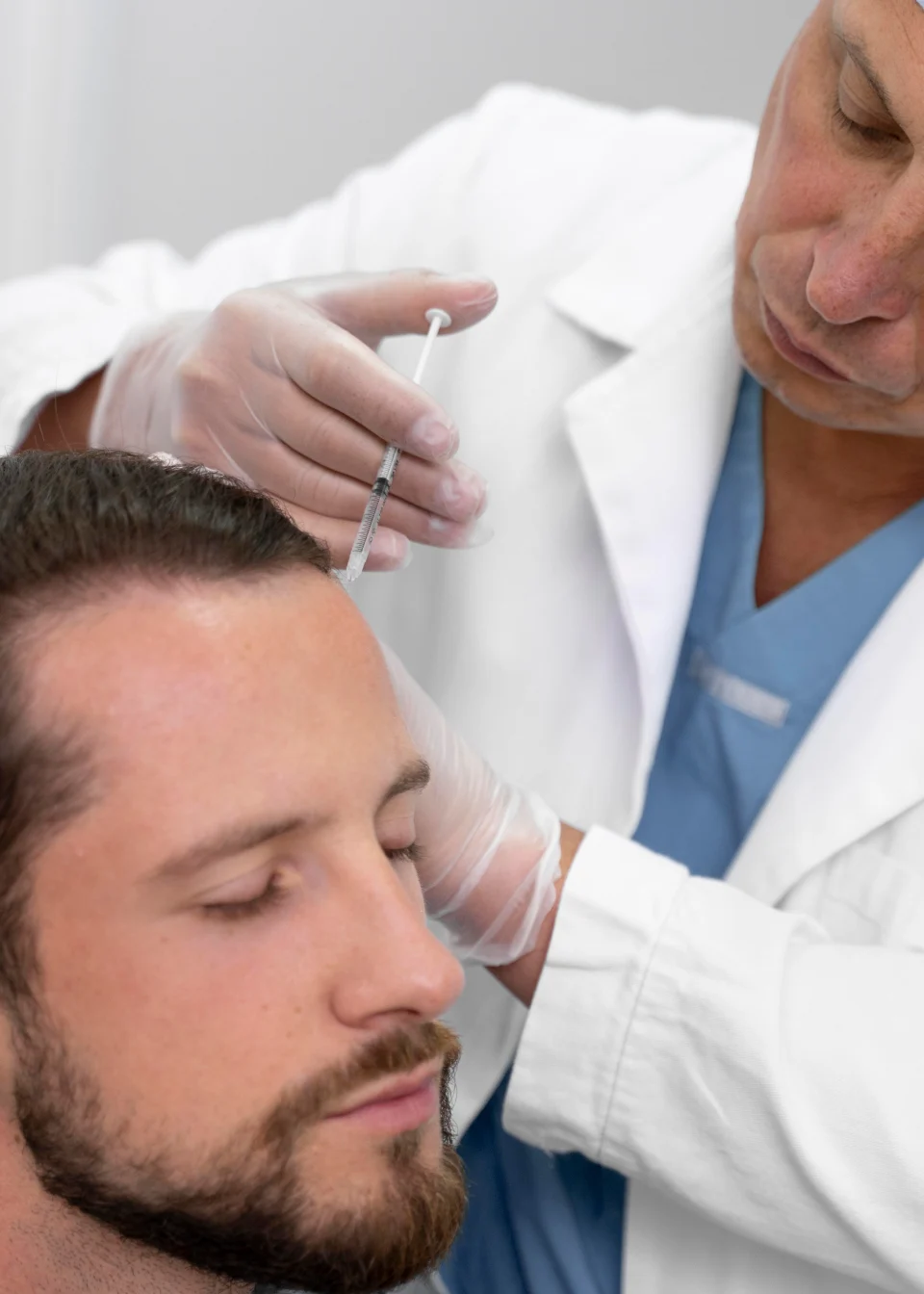
Most men who look into a hair transplant have the same worry: the shaved head. Two weeks with a buzzed scalp and visible scabs is easy to hide on holiday, much harder if you have to walk back into an office, a classroom or a client meeting. That is why the unshaven, or no-shave, DHI hair transplant has become one of the most requested options in 2026. Here is how it works, who it suits, where its limits are and what it costs at our clinic in Tirana.
What is an unshaven DHI hair transplant?
An unshaven DHI (Direct Hair Implantation) transplant is a procedure in which the existing hair is left at its normal length, or mostly so, during the operation. In a standard transplant the whole head is clipped short so the team can see every follicle clearly. In a no-shave procedure the hair is kept long in the recipient area, and grafts are placed between the existing hairs with a Choi implanter pen. You can read about the pen technique itself on our DHI hair transplant page.
In practice there are three variations, and the term is used loosely across the industry, so it is worth asking any clinic exactly which one it means:
- Fully unshaven: no hair is shaved anywhere. Grafts are extracted one by one from between long hairs and implanted between long hairs. This is slow and suited only to small sessions.
- Partially shaven (long-hair or strip-shave donor): the recipient area stays long, while a narrow band or a few small windows in the donor area at the back are shaved and then covered by the hair above them.
- Recipient-only unshaven: the donor area is clipped short, but the top and front are left untouched. A short back and sides haircut usually hides this well.
Why does the shaving question matter so much?
For most patients it is not about vanity, it is about privacy and time off. With a fully shaved transplant you can typically expect the scalp to look obviously treated for 10 to 14 days. With a no-shave approach, the existing hair falls over the implanted area and covers most of the redness and small crusts. Many patients return to work within 2 to 5 days without colleagues noticing anything beyond, perhaps, a slightly different parting. That said, results vary: very fine or very short hair hides less, and some redness can still be visible in bright light.
Who is a good candidate for a no-shave transplant?
The unshaven technique works best when the goal is refinement rather than full reconstruction. Typical good candidates include:
- Men with early recession at the temples (roughly Norwood 2 to 3) who want the hairline rebuilt.
- Patients with diffuse thinning on top who still have enough native hair to act as camouflage.
- Women, who very rarely want or need to shave their head (see our female hair transplant guide).
- Patients who had a previous transplant and need a small density top-up or scar repair.
It is usually less suitable for advanced baldness (Norwood 5 and above). When there is little or no native hair in the recipient area, there is nothing to hide the grafts behind, and the session would need far more grafts than can be extracted efficiently without shaving. In those cases a classic shaved procedure, often with Sapphire FUE, is generally the better choice.
Shaved vs unshaven DHI: how do they compare?
| Factor | Unshaven DHI | Classic shaved DHI or Sapphire FUE |
|---|---|---|
| Typical graft range per session | About 1,000 to 2,500 grafts | About 2,500 to 4,000+ grafts |
| Procedure time | Longer per graft, often 7 to 9 hours | Usually 6 to 8 hours |
| Visibility after surgery | Mostly hidden by existing hair | Clearly visible for 10 to 14 days |
| Typical return to work | About 2 to 5 days | About 7 to 14 days, or with a hat |
| Best suited to | Hairline, temples, diffuse thinning, women | Larger bald areas, crown, high Norwood stages |
| Shock loss risk in native hair | Present, usually temporary | Present, usually temporary |
The figures above are typical ranges, not promises: your graft count and timeline depend on your donor density, hair type and the size of the area being treated.
How does the procedure day work?
The day follows the same structure as any DHI procedure, just with more patience. After a consultation and hairline planning (we explain this in detail in our guide to hairline design), the area is numbed with local anaesthesia. Grafts are extracted from the donor area, either from shaved windows or between long hairs, and kept in a cooled storage solution. The team then loads each graft into a Choi pen and implants it at the planned angle and direction, working between your existing hairs so they are not damaged.
Because every graft has to be threaded between long hairs, the implantation phase takes longer. This is one reason most clinics, including ours, limit unshaven sessions to a moderate number of grafts and do not combine them with very large coverage goals.
What are the downsides and risks?
An honest answer matters here. The main limitations are:
- Lower maximum graft count. If you need 3,500 grafts, an unshaven session will not deliver them in one day.
- Shock loss. Native hairs near the implanted grafts can shed temporarily in the first weeks. In most cases they grow back within 3 to 4 months, but this can briefly make the area look thinner.
- Not every hair type hides grafts equally. Very short, very straight or very fine hair offers less coverage.
- Longer surgery time. More hours in the chair, although breaks and local anaesthesia keep it comfortable for most people.
Like any surgical procedure, a transplant carries small risks such as infection, swelling or patchy growth. These are uncommon when aftercare is followed, and the team reviews your medical history beforehand to reduce them.
How much does an unshaven DHI transplant cost in Albania?
At Nouvelle Clinique, hair transplant packages range from €1,500 to €3,000 depending on technique and graft needs. Our fixed all-inclusive package is €2,500 and covers the procedure, medications, hotel accommodation and airport transfers in Tirana. You can secure a date with a €200 online deposit. For a full breakdown of what affects price, see our 2026 hair transplant cost guide. Published figures for Italy or Germany are about three times the price of our full package, for the procedure alone.
What does recovery look like?
Recovery after an unshaven transplant is similar to a standard DHI recovery, with the advantage of better camouflage. Expect mild swelling for 2 to 4 days, small crusts that fall off around days 7 to 10, and the usual shedding of transplanted hair shafts between weeks 2 and 6. New growth typically starts around month 3 to 4, with the final result visible at around 12 months. Our week-by-week recovery timeline covers each stage, and you can see real outcomes on our results page.
Frequently asked questions
Is a no-shave hair transplant completely invisible afterwards?
Not completely, but it is far more discreet than a shaved procedure. Most patients find that their existing hair covers the treated area well enough to return to work within a few days, although some redness may be visible up close for one to two weeks.
How many grafts can be done without shaving?
Typically about 1,000 to 2,500 grafts in one session, depending on your hair length, density and the donor technique used. Larger needs are usually better handled with a shaved session or split into two procedures.
Does an unshaven DHI transplant give worse results?
Graft survival is generally comparable when the procedure is done carefully. The difference is in how many grafts can be placed and how long it takes, not in the quality of the hair that grows.
Do I need to shave the back of my head?
Often a small strip or a few windows in the donor area are shaved and then hidden under longer hair above them. A fully unshaven donor is possible for small sessions. We will tell you which option fits your case during the consultation.
Can women have an unshaven DHI transplant?
Yes. Women are among the most common candidates for no-shave DHI, because the goal is usually to add density along the parting or hairline without changing their hairstyle.
Is an unshaven DHI transplant right for you?
If you want to restore your hairline or add density without disappearing for two weeks, a no-shave DHI transplant may be the right fit. The best way to know is to send us a few photos of your scalp for a free online consultation: our team will tell you honestly whether unshaven DHI suits your case, roughly how many grafts you need, and what the package includes. Message us on WhatsApp at +355 69 745 6238, or check available dates and reserve your procedure with a €200 deposit.
Medical review: the clinical information on this page is reviewed by the Nouvelle Clinique medical team under the supervision of Dr. Elvira Frangu, MD (Faculty of Medicine, University of Tirana; Order of Physicians of Albania, Registry No. 3973). This content is informational and is not a substitute for an individual medical consultation.