
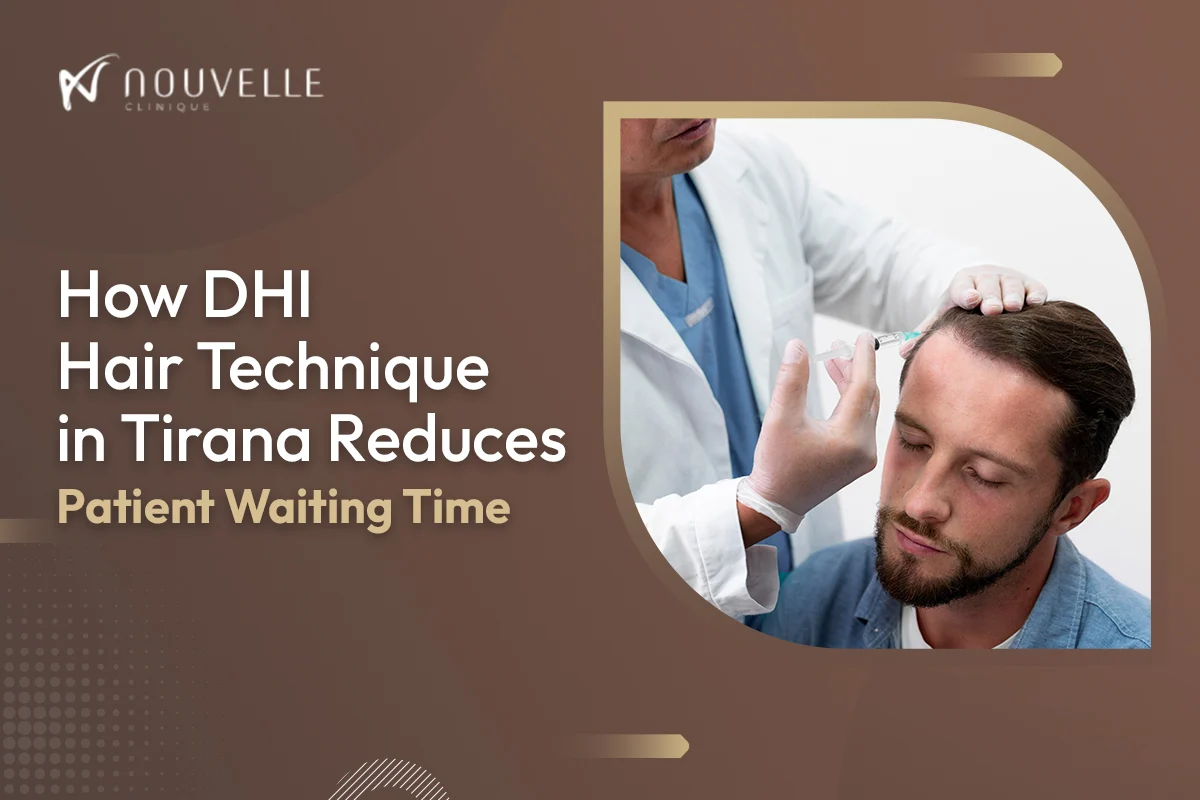
Ask ten patients what worried them most before a hair transplant and most will say the same thing: “Will it look natural?” The answer is decided before a single graft is placed, at the drawing stage — the hairline design. A transplant with 3,000 perfectly healthy grafts and a badly drawn line looks like a transplant. A transplant with fewer grafts and a well-designed line looks like hair. This guide explains how a natural hairline is planned at Nouvelle Clinique in Tirana, what makes one look wrong, and what you should ask your surgeon before you agree to the design.
What a natural hairline actually looks like
Natural hairlines are not lines. They are transition zones, usually 1–1.5 cm deep, in which single, fine hairs at the front give way to pairs and then to groups of three or four further back. They are also slightly irregular: small forward and backward bumps that photographers call “micro-irregularities”. And they are asymmetric — the two temples are rarely mirror images. A hairline drawn as a straight, dense, symmetric edge is the single most common reason a transplant is recognisable from across a room.
| Feature | Natural hairline | Poorly designed transplant |
|---|---|---|
| Front edge | Soft, single fine hairs, low density | Sharp, dense, “wall” of hair |
| Shape | Gentle M or oval with irregular bumps | Straight line or perfect curve |
| Height | Matches age and face proportions | Too low, teenage position on an adult face |
| Temples | Recede slightly, blend into the side hair | Filled square, no recession |
| Hair direction | Forward and slightly downward, varying by zone | Uniform angle, often too upright |
The four decisions in hairline design
1. Height
The most consequential decision, and the one where patients push hardest in the wrong direction. Most men who lose their hair want the hairline of their twenties back. But a hairline that looks right at 22 looks wrong at 45, and — because hair loss continues after a transplant — it also commits future grafts to an area that may not be sustainable. The usual reference point is around 7–8 cm above the glabella (the point between the eyebrows), adjusted for forehead height, age and how much donor hair is available. A surgeon who agrees to whatever height you ask for is not doing you a favour.
2. Shape
The shape is chosen to suit the face: rounder faces usually take a slightly more oval line, longer faces a flatter one with a modest widow’s peak. The temples are deliberately left with a gentle recession — filling them square is the classic error of over-ambitious designs. Once the outline is agreed, the surgeon breaks the line up with micro-irregularities so that no segment is straight for more than a centimetre or so.
3. Density gradient
The front 1 cm is planted with single-hair grafts only, at lower density; behind it, two-hair grafts; behind that, the three- and four-hair units that provide most of the visual fullness. This gradient is what makes a hairline “soft”. Techniques such as DHI, where each graft is placed with an implanter pen, give the most control here because the surgeon sets the depth and angle of every single graft, and Sapphire FUE allows very fine, closely spaced incisions in the hairline zone.
4. Direction and angle
Hair at the front of the scalp grows forward and downward at a low angle, typically 15–30 degrees to the skin; in the temples it turns outward and downward. Grafts placed too upright are the second most common giveaway after a straight line. This is set incision by incision and is one of the reasons hairline work takes longer per graft than crown work.
How the design happens on the day
The design is drawn on your forehead with a marker before any anaesthetic, with you sitting upright and looking in a mirror, so that you can see the proposed line from your normal viewing angle. This is the moment to speak up. The line is adjusted until both you and the surgeon are satisfied — a good clinic will redraw it three or four times if needed, and will explain why it declines a request rather than just agreeing. Photographs are taken of the final design and become part of your medical record. Only then does the procedure begin. If you are considering a transplant, our week-by-week recovery guide explains what the hairline looks like in the months that follow: the transplanted hairs shed at weeks 2–4 and the final line is only visible at 12–15 months.
Common mistakes we correct in repair cases
A meaningful share of the patients we see have had a transplant elsewhere. The problems are nearly always at the hairline: a line placed too low, temples closed square, grafts of three and four hairs placed at the front edge, or an upright angle that makes the hair stand rather than lie. Some of these can be softened with a second, smaller session; some need the misplaced grafts removed first. Prevention is much cheaper than repair — which is exactly why the design conversation deserves more attention than the graft count.
Questions to ask before you agree to a design
Ask where the hairline will sit in ten years if your loss continues, and how the plan accounts for that. Ask what graft sizes will be used in the first centimetre. Ask to see results on patients of your age and hair type, not only the best cases. Ask who draws the line and who places the frontal grafts. And ask what happens if you want the line lower than the surgeon recommends — a clinic that simply says yes is telling you something about how it works.
Hairline transplant cost in Albania
A hairline-only session usually needs 1,200–2,000 grafts. At Nouvelle Clinique the all-inclusive package is a fixed €2,500, with complete packages in the €1,500–€3,000 range depending on grafts and technique, a €200 deposit to reserve a date, and hotel and airport transfers included. The full breakdown is in our 2026 price guide, and you can see real hairline results on our results page.
Frequently asked questions
Can I choose my own hairline?
You take part in choosing it — the line is drawn with you and adjusted until you agree. But the surgeon will advise against a design that is too low or too straight, because it will look artificial and may not be sustainable as hair loss continues.
How low can a hairline be placed?
As a rule of thumb, no lower than about 7 cm above the point between the eyebrows for an adult male, and often higher. The exact position depends on your forehead, age, family history of hair loss and donor supply.
Will the hairline look natural immediately?
No. The transplanted hairs shed in the first month and regrow from around month three. The soft, natural appearance of the frontal zone is only visible at 9–12 months, with final density at 12–15 months.
Is DHI better than FUE for the hairline?
Both can produce an excellent hairline. DHI offers the most precise control over angle and depth of each graft, which many surgeons prefer for the front edge; Sapphire FUE allows very fine incisions and is often used for larger areas. Many procedures combine the two.
Can a bad hairline be fixed?
Usually, yes — by softening the edge with single-hair grafts, adjusting the shape, or removing misplaced grafts. Repair is more complex and more expensive than a correct first design, which is why the planning stage matters so much.
Ready to talk about your own hairline? Book a free consultation — you will receive a written assessment and a fixed quote before you travel.
Medical review: the clinical information on this page is reviewed by the Nouvelle Clinique medical team under the supervision of Dr. Elvira Frangu, MD (Faculty of Medicine, University of Tirana; Order of Physicians of Albania, Registry No. 3973). This content is informational and is not a substitute for an individual medical consultation.