
Most hair lost during chemotherapy grows back. For some people it does not, or not fully, and after everything else they have been through that can be hard to accept. This guide explains when a hair transplant is an option after cancer treatment, when it is better to wait, and what a clinic should ask before it agrees to treat you. It does not replace the advice of your oncologist.
Does hair grow back after cancer treatment?
Usually, yes. Chemotherapy affects fast-dividing cells, including those in the hair follicle, but in most cases the follicle recovers. Regrowth typically starts within three to six months of the last cycle, sometimes with a different texture or colour at first. A transplant is not needed in that situation, and no clinic should offer one.
In a minority of patients regrowth stays incomplete. This is more likely after certain chemotherapy drugs, after radiotherapy to the head, where hair in the treated area may not return, and during long-term hormone therapy, which can thin the hair for as long as it is taken.
When a transplant can be considered
| Condition | Why it matters |
|---|---|
| Treatment has ended | A transplant is never done during chemotherapy or radiotherapy |
| At least 12 months have passed | Hair can keep recovering for a year or more; operating earlier risks treating loss that would have resolved by itself |
| The loss is stable | Photos taken months apart should look the same |
| Your oncologist agrees in writing | Only they know your treatment, your current health and your medication |
| The donor area is strong enough | Grafts come from the back and sides of your own scalp; if that hair is also thin, there is little to move |
| The scalp skin is healthy | Skin that received radiotherapy can have a weaker blood supply, which makes graft survival less predictable |
What a careful clinic does differently
For a patient with a history of cancer, the consultation takes longer. Expect to be asked for your diagnosis and treatment dates, the letter from your oncologist and recent blood tests. On skin that has had radiotherapy, the physician may suggest a small test session first, to see how the grafts take before planning a full procedure. And the plan should be conservative: fewer grafts, placed where they make the most difference. A clinic that quotes a graft number without asking about your treatment is not being careful.
Which techniques are used
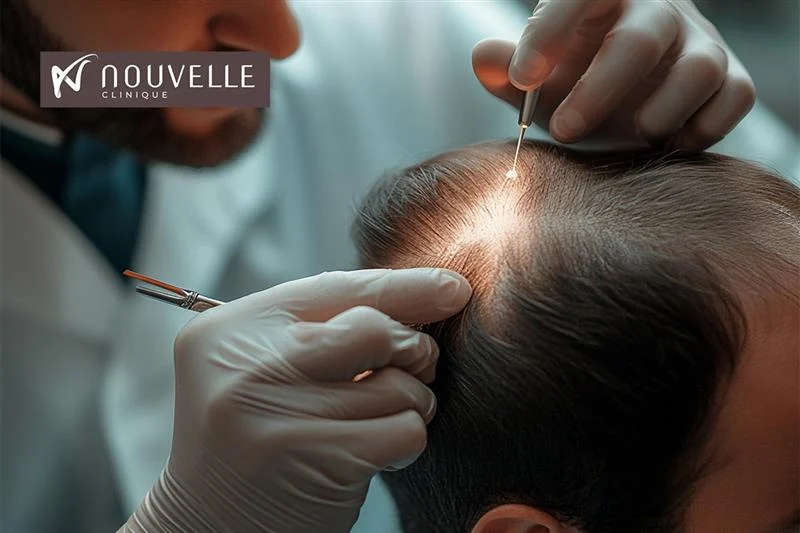
The procedure itself is the same as for any other patient: DHI or Sapphire FUE, under local anaesthesia, with no linear scar. DHI is often preferred for smaller areas and for work between existing hairs, because it does not require shaving the whole head. The recovery timeline is the same too, with the final result at 12 to 15 months.
If a transplant is not possible yet
Waiting is often the right answer, and it is not the only one. Hair systems and wigs have improved a great deal. Scalp micropigmentation can make thin hair look denser. Medication and PRP are sometimes used to support regrowth, but only with your oncologist’s agreement, because some treatments are not suitable after certain cancers. Eyebrows usually return on their own; where they do not, an eyebrow transplant follows the same conditions as above.
Frequently asked questions
How long after chemotherapy can I have a hair transplant?
We ask for at least 12 months after the end of treatment, stable hair loss and written clearance from your oncologist. Many patients find that by then their hair has recovered enough that no procedure is needed.
Is a hair transplant safe after cancer?
For patients whose treatment has ended and whose oncologist agrees, it is a minor procedure under local anaesthesia. The decision is individual and depends on your health, your medication and the condition of your scalp.
Will transplanted hair fall out if I need treatment again?
Transplanted hair behaves like the rest of your hair. If a future treatment causes hair loss, the transplanted hairs can shed too, and they usually regrow in the same way.
Can I have a transplant while I am on hormone therapy?
Sometimes, but this is a question for your oncologist first. Hormone therapy can keep thinning the hair while you take it, so the result of a transplant done during treatment is harder to predict.
What does a transplant cost after cancer treatment?
The same as for any patient: the full package at Nouvelle Clinique is €2,500, and smaller procedures are quoted individually after the assessment. Details are in the 2026 cost guide.
Start with a conversation
If you are a year or more past treatment and your hair has not come back as you hoped, send us your photos and tell us about your treatment. Book a free consultation and you will get an honest answer, including “wait” if that is the right one.
Medical review: the clinical information on this page is reviewed by the Nouvelle Clinique medical team under the supervision of Dr. Elvira Frangu, MD (Faculty of Medicine, University of Tirana; Order of Physicians of Albania, Registry No. 3973). This content is informational and is not a substitute for an individual medical consultation.