
PRP is one of the most common non-surgical treatments for hair loss, and the first question patients ask is always the same: is it safe? For most healthy adults the answer is yes, because the treatment uses your own blood. This guide covers the rest: how PRP works, who it helps and who it does not, what it costs in Albania, and how it compares with the other options that do not involve surgery.
How PRP works
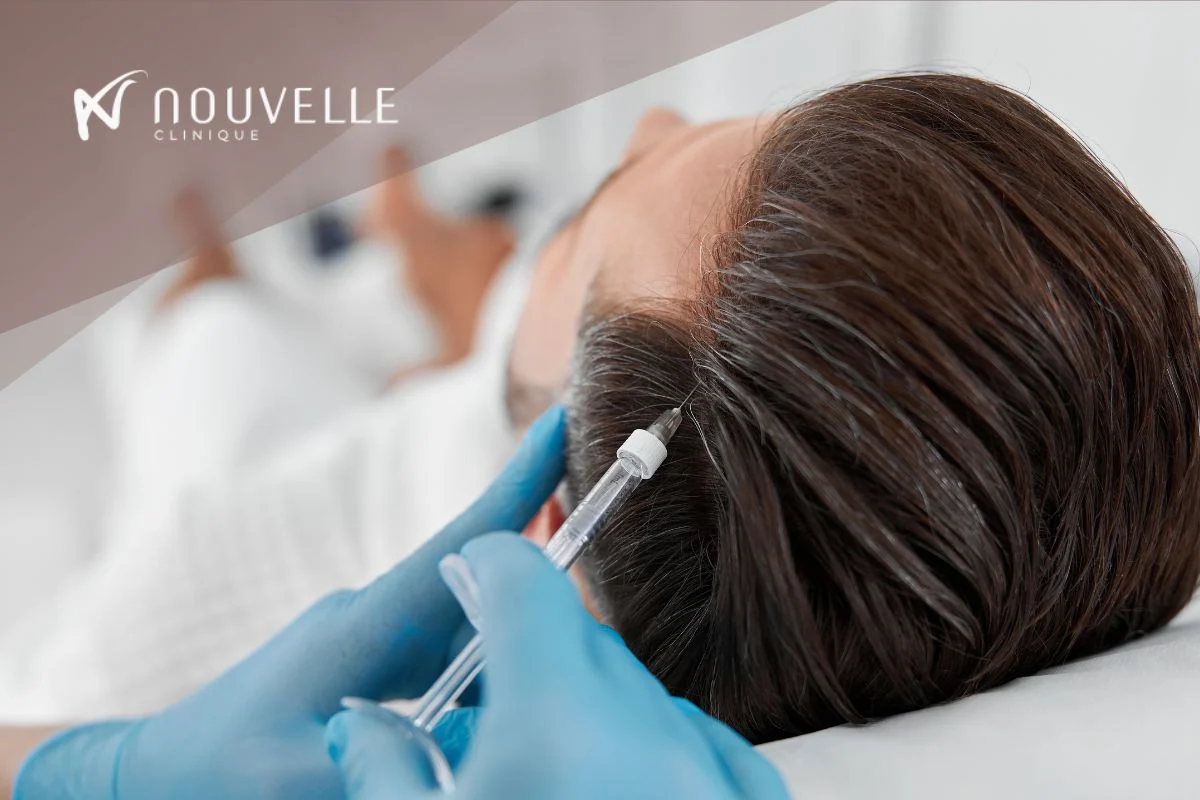
PRP uses your own blood: a small sample is spun in a centrifuge to concentrate the platelets, and the resulting plasma is injected into thinning areas of the scalp. Platelets release growth factors that support follicle activity. In practice, PRP works best for early-stage thinning where follicles are weakened but still alive — it cannot revive follicles that are already gone. Most protocols run 3–4 sessions a few weeks apart, then maintenance every 4–6 months. At Nouvelle Clinique, PRP hair treatment starts from €150 per session and is also used alongside transplants to support graft survival.
Is PRP hair treatment safe?
For most healthy adults, yes. PRP is prepared from your own blood, so there is no risk of an allergic reaction to a foreign substance, and nothing synthetic is injected. The side effects are those of any injection in the scalp: tenderness, mild swelling, redness or a small bruise, usually gone within a day or two. Infection is rare when the treatment is done under sterile conditions with single-use materials.
PRP is not suitable for everyone. It is usually postponed or ruled out for people with a blood or platelet disorder, people on blood-thinning medication, anyone with an active infection or skin disease on the scalp, and during pregnancy. That is why a medical assessment comes first. Nouvelle Clinique operates under a physician licensed by the Order of Physicians of Albania, and your health and medication history are reviewed before any treatment.
PRP for alopecia: what it can and cannot do
Alopecia simply means hair loss, and the type of alopecia decides whether PRP is worth trying.
| Type of hair loss | What PRP can do |
|---|---|
| Androgenetic alopecia (male and female pattern hair loss) | The best-studied use. PRP can reduce shedding and thicken hairs that are thinning, most clearly in the early stages |
| Alopecia areata (patchy, autoimmune hair loss) | Results are mixed. It is treated first by a dermatologist; PRP is sometimes added, not used alone |
| Traction alopecia (from tight hairstyles) | May help in early cases, once the pulling has stopped and the follicles are still alive |
| Scarring alopecia | PRP cannot regrow hair where follicles have been replaced by scar tissue |
The rule behind the table is simple: PRP supports follicles that are weakened but alive. It does not create new follicles. Where an area is already bald, the honest options are a transplant or a cosmetic solution, not more injections.
Who is a good candidate for PRP
PRP makes most sense if your thinning is recent, if you can still see fine hairs in the area, or if you want to support the hair you have after a transplant. It is also a reasonable first step for patients under 25 whose pattern is still changing. It is the wrong tool for a hairline that has already receded or a crown that is already smooth. For those cases, see how PRP compares with a DHI transplant.
The other non-surgical options
Medical management
Two medications have the strongest evidence for slowing hereditary hair loss: topical minoxidil and oral finasteride (for men). They do not build a new hairline, but they can stabilise what you have — which is exactly why surgeons recommend them to young patients whose pattern has not settled. Both require ongoing use and a doctor’s assessment of side effects. Discuss them with a physician before starting; our supervising doctor reviews medication history at every consultation.
Low-level laser therapy (LLLT)
Laser caps and combs use red light to stimulate the scalp. The evidence is moderate: some patients see thicker hair after several months of daily use, others see little. It is safe and non-invasive, but slow and best seen as a supporting measure, not a primary treatment.
Scalp micropigmentation (SMP)
SMP tattoos tiny dots that mimic shaved hair follicles. It creates the look of density on a buzz cut or fills in a thinning crown visually. It grows nothing — it is a cosmetic illusion — but it is a legitimate option for men who wear their hair very short or have a donor area too weak for transplantation.
Hair systems and concealers
Fibres, sprays and modern hair systems are instant and reversible. They suit patients who are not ready for any procedure, or as a bridge during the months a transplant takes to grow in.
How non-surgical options compare
| Option | Grows new hair? | Best for | Commitment |
|---|---|---|---|
| PRP | Supports existing follicles | Early thinning, post-transplant support | 3–4 sessions + maintenance |
| Medication | Slows loss, some regrowth | Stabilising a progressing pattern | Ongoing daily use |
| LLLT | Modest, variable | Supporting measure | Daily, months |
| SMP | No — visual only | Shaved styles, weak donor area | 2–3 sessions, touch-ups |
| Hair transplant | Yes — permanent | Stable pattern, good donor area | One procedure, 12–15 month result |
When non-surgical is the right first step — and when it is not
Non-surgical treatments make sense if your hair loss is early, your pattern is still changing (typically under 25), or you want to stabilise before committing. They are the wrong choice if follicles in the thinning area are already gone: no cream or injection regrows a bald hairline. In those cases the honest options are a DHI or Sapphire FUE transplant — often combined with PRP for the best long-term outcome. Our guide on the best age for a hair transplant explains how surgeons make this call.
Frequently asked questions
Is PRP hair treatment painful?
Most patients describe it as uncomfortable rather than painful. The injections are quick and done with a fine needle, and any tenderness usually fades within a day.
Can PRP replace a hair transplant?
No. PRP strengthens follicles that are still alive; it cannot restore areas that are already bald. It is a complement to a transplant or a first step for early thinning, not a substitute.
How long before non-surgical treatments show results?
Typically 3–6 months of consistent treatment before changes are visible, whether PRP, medication or laser. Stopping usually means gradual return to the previous trajectory.
Is it worth trying non-surgical options before travelling for a transplant?
Often yes, especially for younger patients — stabilising the pattern first makes transplant planning more reliable. A consultation will tell you whether your case benefits from waiting.
Can I combine PRP with a transplant on the same trip?
Yes. Many patients at Nouvelle Clinique have PRP during the same visit to support graft healing, and return for maintenance sessions later or arrange them locally.
What does non-surgical treatment cost in Albania?
PRP from €150 per session; medications are inexpensive and available through any pharmacy after a prescription. Transplant packages run €1,500–€3,000 — see the 2026 cost guide.
Get an honest recommendation
Whether you need PRP, medication, a transplant or simply time, the first step is the same: a specialist assessment. Book a free consultation and you will get a clear answer — including “not yet” if that is the truth.
Medical review: the clinical information on this page is reviewed by the Nouvelle Clinique medical team under the supervision of Dr. Elvira Frangu, MD (Faculty of Medicine, University of Tirana; Order of Physicians of Albania, Registry No. 3973). This content is informational and is not a substitute for an individual medical consultation.